|
|
| Line 7: |
Line 7: |
| == One subnets, Two IP Addresses, Untagged == | | == One subnets, Two IP Addresses, Untagged == |
|
| |
|
| [image of network configuration 1] | | [[Image:UseCase_OneSubTwoIpUntagged_0.png]] |
|
| |
|
| {| | | {| |
Revision as of 14:19, 23 April 2015
Applies to version(s): v2.8.
This article provides the steps required to complete the most common IP network configurations using the Web Portal.
One subnets, Two IP Addresses, Untagged
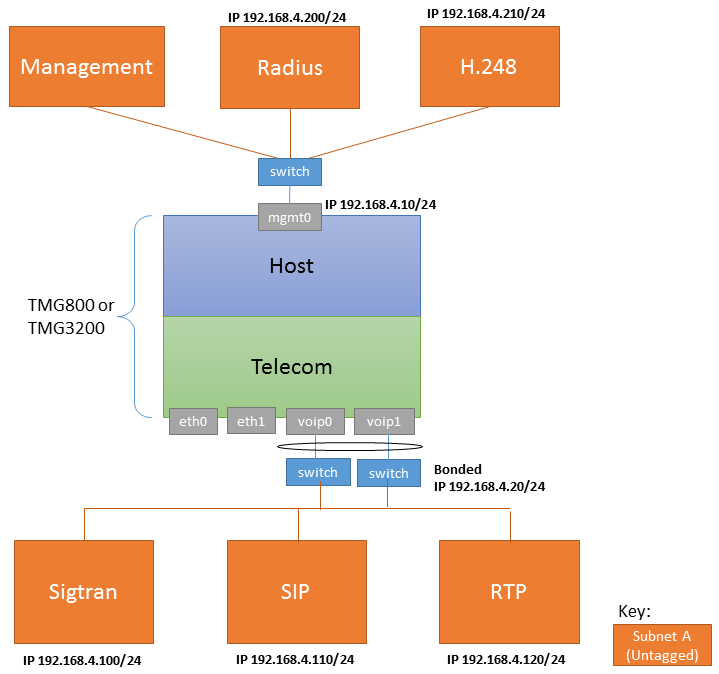
| Configure IP Network A
|
Configure IP Network B
|
|
Subnet A uses the MGMT0 and because it is untagged, can only change with tbchangeip
|
Subnet B uses untag bonded over VOIP0 and VOIP1 ports
|
| Configure SIP
|
Configure SIGTRAN
|
Configure H.248
|
Configure RADIUS
|
|
|
|
|
|
|
Two subnets, One IP per subnet, untagged
[image of network configuration 2]
| Configure IP Network A
|
Configure IP Network B
|
|
Subnet A uses the MGMT0 and because it is untagged, can only change with tbchangeip
|
Subnet B uses untag bonded over VOIP0 and VOIP1 ports
|
| Configure SIP
|
Configure SIGTRAN
|
Configure H.248
|
Configure RADIUS
|
|
|
|
|
|
|
Two VLAN, Three IP Address, tagged
[image of network configuration 3]
| Configure IP Network A
|
Configure IP Network B
|
|
|
Subnet B uses untag bonded over VOIP0 and VOIP1 ports
|
| Configure SIP
|
Configure SIGTRAN
|
Configure H.248
|
Configure RADIUS
|
|
|
|
|
|
|
