Use Cases:Network Configuration IP UseCase1 A: Difference between revisions
No edit summary |
(Added explanation of IPs used in this diagram) |
||
| Line 15: | Line 15: | ||
[[File:UseCase_OneSubTwoIpUntagged_0.png|link=]] | [[File:UseCase_OneSubTwoIpUntagged_0.png|link=]] | ||
{| | |||
|STYLE="vertical-align: top"| | |||
{| border="1" class="wikitable" | |||
! width="500" style="background: none repeat scroll 0% 0% rgb(0, 83, 139);" | Local IPs | |||
! width="500" style="background: none repeat scroll 0% 0% rgb(0, 83, 139);" | Remote IPs | |||
|- | |||
| | |||
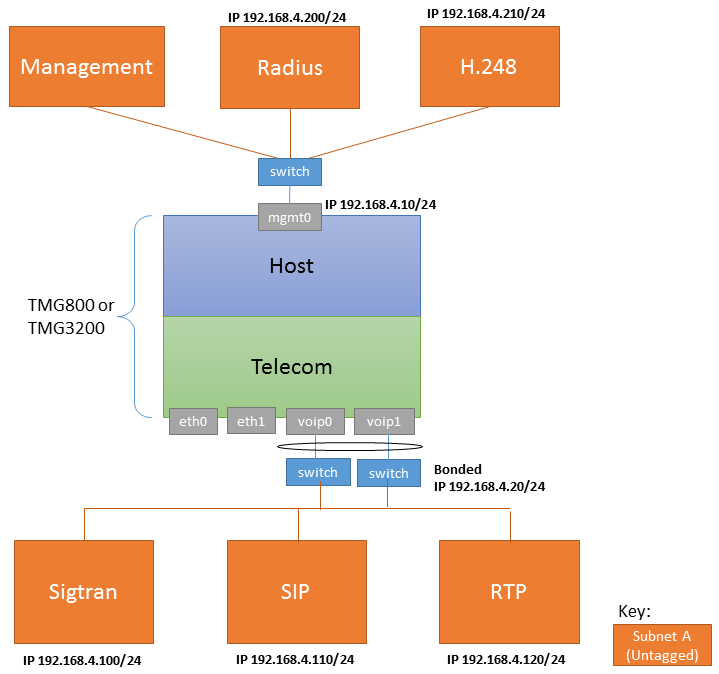
In this example, here are the IPs used: <br> | |||
* Management on mgmt0: 192.168.4.10 | |||
* VoIP on voip0/voip1 (bonded): 192.168.4.20 | |||
| | |||
* Radius server: 192.168.4.200 | |||
* H.248 MGC: 192.168.4.210 | |||
* Remote Sigtran endpoint IP: 192.168.4.100 | |||
* Remote SIP endpoint IP: 192.168.4.110 | |||
* Remote RTP endpoint IP: 192.168.4.120 | |||
|- | |||
|} | |||
{| | {| | ||
|STYLE="vertical-align: top"| | |STYLE="vertical-align: top"| | ||
Revision as of 12:55, 7 March 2024
| This article applies to: | Product | Version |
| Tmedia | 2.9, 2.10, 3.0, 3.2 |
One subnet, Two IP Addresses, Untagged
|